Oven utensils
Maria Ricou from of the Recallers house in Son explains to us about their oven and about the process of how bread was made through the analysis of the oven and the old utensils that have been preserved in perfect condition in the house thanks to the Infiesta Capdevila family.
How was bread made?
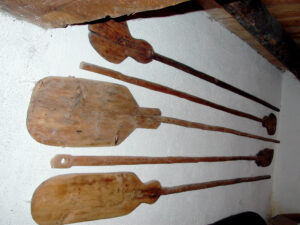
Baker’s peel
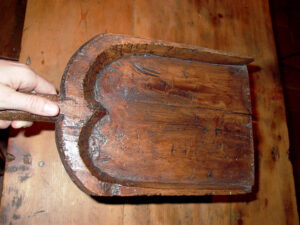
Peel for removing flour from the sieve
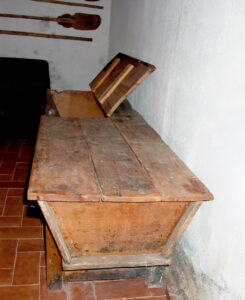
Baking pan
First flour was removed from the sieve using the peel and transferred to the baking pan where the bread dough was kneaded. She explains it herself in the following audio:
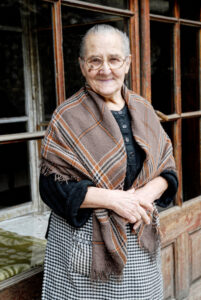
Maria Ricou de Casa Recallers de Son
The loaves as well as cakes were made on the counterand also the cakes were made on the counter. And finally, they were shaped with wooden peels that have very long handles so that they could put the loaves in and take them out of the oven without burning themselves, since the oven was full of very hot coals.
Baking the bread
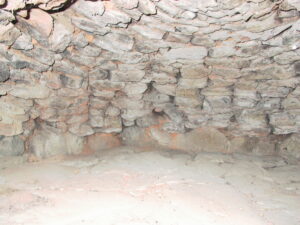
Marble stone
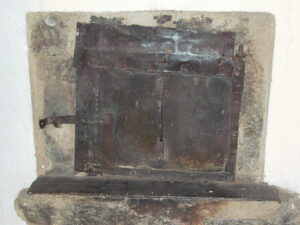
Oven door
The oven door is the original and is made of wrought iron. The oven roof is made of marble stone, which is a stone that can withstand high temperatures. Maria Ricou then explains how the bread was baked:
Maria Ricou de Casa Recallers de Son
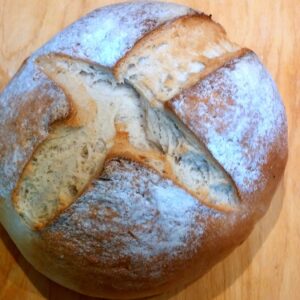
May God do more than we do!
Documentation that tells us about the village's ovens
In the village of Son, there is evidence of several ovens dating back to 1669, recorded in the Capbreu de les Valls d’Àneu. At that time, the ovens were privately owned. The document specifically states that there were no communal ovens and that each household could build its own oven at home.
Later, however, there is evidence that at least one bread oven became a public facility, owned by the Comú de Son.
The Comú was the collective body responsible for the lands and assets held in common by the inhabitants of a village, such as forests, pastureland, paths and water resources. It also included communal buildings and facilities, such as mills, ovens, shops and the tavern. Essentially these were the basic structures needed to ensure the subsistence and functioning of the local community. The representatives of the Council of Son were responsible for administering the Comú’s assets, which did not belong to an individual owner but to the inhabitants as a whole.
In documents dating from after the Decree of Nueva Planta (1714), during the Bourbon period, the facilities belonging to the Comú were also referred to by the Spanish term Propios y Arbitrios. Propios referred to ordinary municipal revenues derived from communal or patrimonial assets, while Arbitrios were extraordinary municipal taxes levied on the use of the facilities.
In 1769, we find a document referring to the oven. It is a lease agreement stating that Manuel Verdié leased a bread-baking oven, with an annual rent of twenty lliures, which he was required to pay to the village. Following the same formula, another lease agreement from 1782 records how Antonio Juclà of Son, acting on behalf of the Town Council of Son, listed the village’s Propios y Arbitrios. That year, the lease of the bread oven was held by Jaume Farrer, also at an annual cost of twenty lliures.
The lease was annual and was subject to a Taba d’arrendament, a written set of regulations specifying the lessee’s obligations as well as the rules governing the operation of the oven.
According to documentation dated 1795, we know that the oven’s lessee was required to allow the villagers to come to his premises to knead and bake their bread. His responsibility was to keep the oven constantly heated, with embers ready for baking. It is also specified that “the lessee must maintain the ovens with peels, tables and covers.” The villagers paid for its use with a proportional share of the bread they baked: “The Comú requires that all individuals who knead their dough at the village oven must pay two lliures of bread per quarter, except those who are exempt.”
The document also stipulated a fine of 125 lliures, payable each time by anyone who used the oven without the lessee’s permission. There was also a penalty for anyone causing damage to the oven: “The Comú decrees that any individual who causes damage to the said ovens shall restore them at their own expense and serve three days in prison.”
Comú: the medieval communal institution that managed the village’s shared lands, buildings and resources.
Lliura/lliures: a historical unit of currency used in Catalonia before the modern monetary system.
Capbreu: a medieval and early modern land register recording property rights and obligations.
Taba d’arrendament: the written regulations governing the lease and operation of the communal oven.
- Cover photo: old oven of Casa Recallers
- Photographs taken courtesy of the Infiesta Capdevila family
- Original audios courtesy of Maria Ricou
- Photographs, audios and historical research carried out by Clara Anyó